


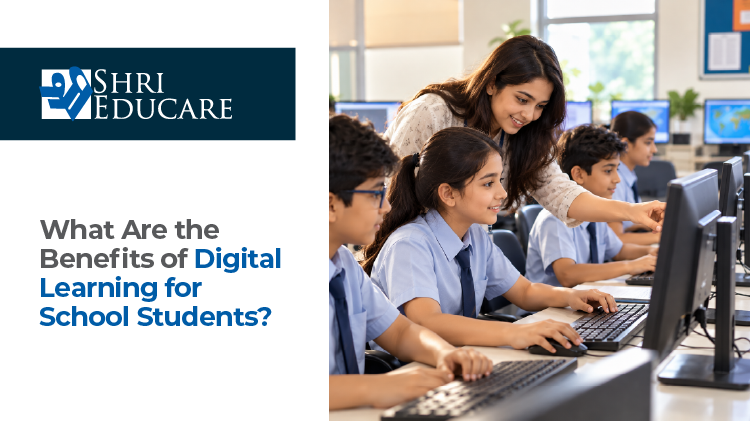
Learning is no longer limited to a blackboard, notebook and textbook. Today, students can watch a short video, open an interactive lesson, take a quiz or explore a topic online within minutes. This is one reason the benefits of digital learning for students are becoming more visible in everyday education.
At the same time, digital learning in schools is not about replacing teachers with screens. It works best when technology supports good teaching and helps students understand lessons in a clearer and more engaging way.
Top Benefits of Digital Learning for School Students
Makes Lessons More Interesting
Some topics can feel difficult when students only read about them from a book.
Videos, animations, images, quizzes and interactive activities can make a lesson easier to follow. A science process, for example, may make more sense when students can actually see how it works.
One of the benefits of digital learning for students is that lessons can feel more active instead of being based only on listening and writing.
When digital learning in schools is used carefully, it can add variety to the classroom and help students stay involved.
Helps Students Learn at Their Own Pace
Not every child learns at the same speed. Some understand a topic quickly, while others need a little more time.
Digital tools allow students to replay a video, read an explanation again or practise a question more than once.
This is one of the useful benefits of digital learning for students, especially when a child needs extra practice. Teachers can also offer different learning material based on a student’s level and needs.
Makes Difficult Ideas Easier to Understand
Some ideas are simply hard to explain with words alone.
Think about the solar system, the human body, maps, maths shapes or scientific experiments. Pictures, videos and digital models can make these topics much easier to understand.
The benefits of digital learning for students include being able to see and explore ideas instead of only reading about them.
This is where digital learning in schools can make a real difference. A topic that seemed confusing at first may suddenly start to make sense.
Gives Students More Ways to Practise
Practice is a big part of learning. Still, doing the same worksheet again and again can get boring pretty fast.
Online quizzes, learning games, practice exercises and short tests can make revision feel more interesting.
Another of the benefits of digital learning for students is that many tools can give quick feedback. Students can see where they made a mistake and try again.
Through digital learning in schools, practice can become a regular part of learning without always feeling like a test.
Encourages Independent Learning
Students should be able to ask questions, find answers and explore topics on their own.
Digital resources can support this habit. A child who becomes curious about a topic in class may read more about it, watch an educational video or explore an online activity later.
When digital learning in schools is guided properly, students learn that technology can be used for learning, not only for entertainment.
Supports Different Learning Styles
Some students learn better by reading. Others understand more through pictures, sound or activities. A teacher can mix these formats in the same lesson.
This flexibility is one of the benefits of digital learning for students because learning does not have to look exactly the same for everyone.
A child who struggles with a written explanation may understand the same idea after seeing a diagram or short video. Sometimes a small change in how something is taught makes all the difference.
Makes Classroom Learning More Flexible
Students sometimes need to revisit a lesson after school or revise before an exam.
With digital learning in schools, selected learning material can be available beyond the classroom when schools provide suitable access.
This does not mean children should spend the whole day on a device. Technology should support reading, writing, discussion, play and real world learning rather than replace them.
The aim is balance, not more screen time for the sake of it.
Helps Teachers Notice Learning Gaps
Digital quizzes can help teachers see which topics students understand and where they need support. The benefits of digital learning for students become stronger when teachers use this information thoughtfully.
Instead of waiting until a major exam, students may receive help earlier.
In this way, digital learning in schools can support teaching without making technology the centre of every lesson.
Builds Confidence With Technology
Technology is already part of everyday life, so children need to learn how to use it responsibly.
Students can learn to search for useful information, create presentations, complete digital work and understand that not everything online is trustworthy.
The benefits of digital learning for students also include becoming more comfortable with tools they may use later in higher education and work.
Good digital learning in schools should include guidance on safe and thoughtful technology use.
Encourages Collaboration
Technology does not always mean learning alone.
Students can use digital tools for group presentations, shared projects, quizzes and research tasks.
This also reminds students of something important: the device is only a tool. Good learning still depends on questions, ideas, communication and effort.
Working together can also teach children how to listen to different ideas, divide responsibilities and complete a task as a team.
Creates a Balanced Learning Experience
The best classroom does not need to be completely digital.
Books, handwriting, discussions, outdoor activities, experiments, art, sports and projects still matter.
The real benefits of digital learning for students appear when technology becomes one part of a wider learning experience.
A short animation may explain a concept, a classroom discussion may help students think about it and a hands on activity can then make the idea feel real.
That mix often keeps learning fresh without making children depend completely on screens.
Conclusion
Technology can make education more flexible, visual, interactive and easier to explore when it is used with a clear purpose. Digital learning can offer better practice, more ways to understand difficult topics, greater independence and stronger confidence with technology. At the same time, digital learning in schools should remain balanced with books, discussions, practical activities and face to face teaching.
Building strong Digital Literacy Skills is also an important part of helping children use technology safely and wisely.
Shri Educare supports learning approaches that combine useful digital tools with meaningful classroom experiences, helping students grow into confident and responsible learners.