


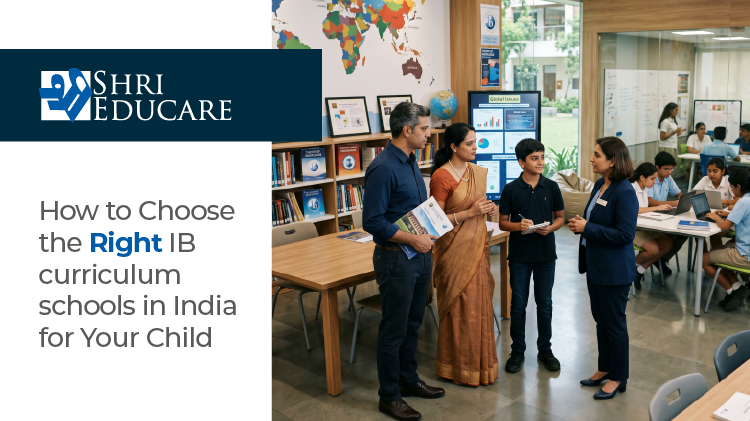
Choosing the right school is one of the most important decisions for any parent. A school does much more than teach subjects. It shapes a child’s thinking, confidence, habits, values and view of the world. This is why many parents are now exploring IB curriculum schools in India for a more global and skill based learning experience.
The International Baccalaureate, commonly known as IB is known for its inquiry based learning style. It encourages students to ask questions, understand ideas deeply, solve problems and connect learning with real life. However, choosing the right IB school requires careful thought. Every school may follow the same curriculum framework but the quality of teaching, environment, leadership and support can be very different.
A Parent’s Guide to Choosing the Right IB Curriculum Schools in India
Understand What the IB Curriculum Offers
Before choosing a school, parents should first understand what makes the IB curriculum different. It is not only about textbooks, marks and exams. It focuses on how children learn, think, express and apply knowledge.
Good IB curriculum schools in India usually focus on research, communication, creativity, international mindedness and independent learning. Students are encouraged to explore topics instead of only memorising answers. This helps them become more confident and aware learners.
The IB approach also supports emotional and social growth. Children learn to work in groups, share ideas, respect different views and take responsibility for their learning. This kind of education can be useful for students who may study or work in a global environment later in life.
Check the School’s IB Authorisation
One of the first things to check is whether the school is officially authorised to offer the IB programme. A school should not only use the word “international” in its name. It should have proper approval to offer the IB curriculum.
Parents should ask which IB programme the school offers. Some schools may offer the Primary Years Programme, some may offer the Middle Years Programme and others may offer the Diploma Programme. Some schools may offer more than one.
Well established IB curriculum schools in India clearly share their authorisation details, programme structure and academic approach. This shows transparency and helps parents understand what their child will actually study.
Look at the Teaching Quality
The quality of teachers plays a major role in IB education. Since the IB method is inquiry based, teachers need strong training and a different teaching style. They should guide students instead of simply giving ready made answers.
In strong IB curriculum schools in India, teachers act more like mentors. They help children ask better questions, discuss ideas, research topics and build their own understanding. This requires patience, subject knowledge and proper IB training.
Parents can check whether teachers receive regular professional development. They can also observe how teachers interact with students during school visits. A warm, confident and well trained teaching team can make a big difference in a child’s learning journey.
Review the Learning Environment
A good IB school should have a learning environment that supports curiosity and exploration. Classrooms should not feel stiff or stressful. They should encourage discussion, activity, reading, thinking and teamwork.
The right IB curriculum schools in India usually provide libraries, labs, activity areas, sports spaces, art rooms, technology access and flexible learning zones. These facilities help students learn beyond the four walls of a classroom.
However, infrastructure alone is not enough. A school may have a beautiful campus but the real value lies in how those spaces are used. Parents should look at whether students are actively involved in projects, presentations, experiments and creative work.
Focus on Holistic Development
IB education gives importance to the overall growth of a child. This includes academics, sports, arts, communication, leadership, emotional balance and social responsibility.
Good IB curriculum schools in India help students grow as complete individuals. They may offer activities such as music theatre, visual arts, debates, sports, community service, clubs and outdoor learning. These experiences help children discover their interests and build confidence.
Holistic development is important because children need more than good marks to do well in life. They need problem solving skills, teamwork, empathy, discipline and the ability to express themselves clearly.
Understand Assessment Methods
Assessment in IB schools is different from the traditional exam only method. Students are assessed through projects, presentations, research work, written tasks, class participation and final evaluations.
Parents should understand how the school tracks student progress. A good school should share regular feedback, not just report cards. Feedback should explain what the child is doing well and where improvement is needed.
This system helps students understand learning as a process. It also reduces the pressure of one final exam deciding everything. Still the school should maintain academic seriousness and clear evaluation standards.
Check Parent Communication
Strong parent school communication is very important, especially in an IB environment. Parents should know how the school shares updates about learning, progress, activities, behaviour and future planning.
Reliable IB curriculum schools in India usually have structured communication systems. These may include parent teacher meetings, digital platforms, progress reports, newsletters, workshops and counselling support.
Good communication helps parents stay connected with the child’s development. It also helps the school and family work together when a child needs support.
Consider Global Exposure and University Readiness
Many parents choose IB because it is recognised by universities across the world. The Diploma Programme, in particular is known for preparing students for higher education.
The right IB curriculum schools in India should support students with career guidance, university counselling, subject selection, profile building and academic planning. This becomes very important in senior classes.
Students should also get exposure to global ideas through projects, international events, exchange opportunities, research work and community based learning. This helps them understand the world with a wider point of view.
Evaluate the School Culture
A school’s culture affects children every day. Parents should look for a school that feels safe, respectful, balanced and child friendly. The environment should not be too harsh or too casual. It should support discipline with care.
Parents can understand school culture by visiting the campus, speaking with admission counsellors, observing students and asking about safety, values, inclusion, student support and discipline policies.
A good school should make children feel seen and supported. This is especially important in an IB setting, where students are expected to think freely and express ideas.
Conclusion
Choosing the right school takes time but it is worth the effort. Parents should look at authorisation, teachers, curriculum quality, infrastructure, assessment style, parent communication, safety, values and long term academic support. The right school should help the child become confident, thoughtful, creative and ready for future opportunities.
The best IB curriculum schools in India are those that balance global learning with strong values and practical life skills.
For parents, educators and investors looking at structured international education models or an IB School Franchise, Shri Educare offers a thoughtful approach to school development, academic systems and quality focused learning.